
Garburator humming but not turning? Dead silent when you flick the switch? Take a breath, you’re in the right place, and there is a fair chance you can fix this yourself in the next two minutes without paying anyone. Most garburators that stop working are jammed or have tripped their own reset button, not broken. Try the steps below first. If they don’t work, then it’s worth a plumber.
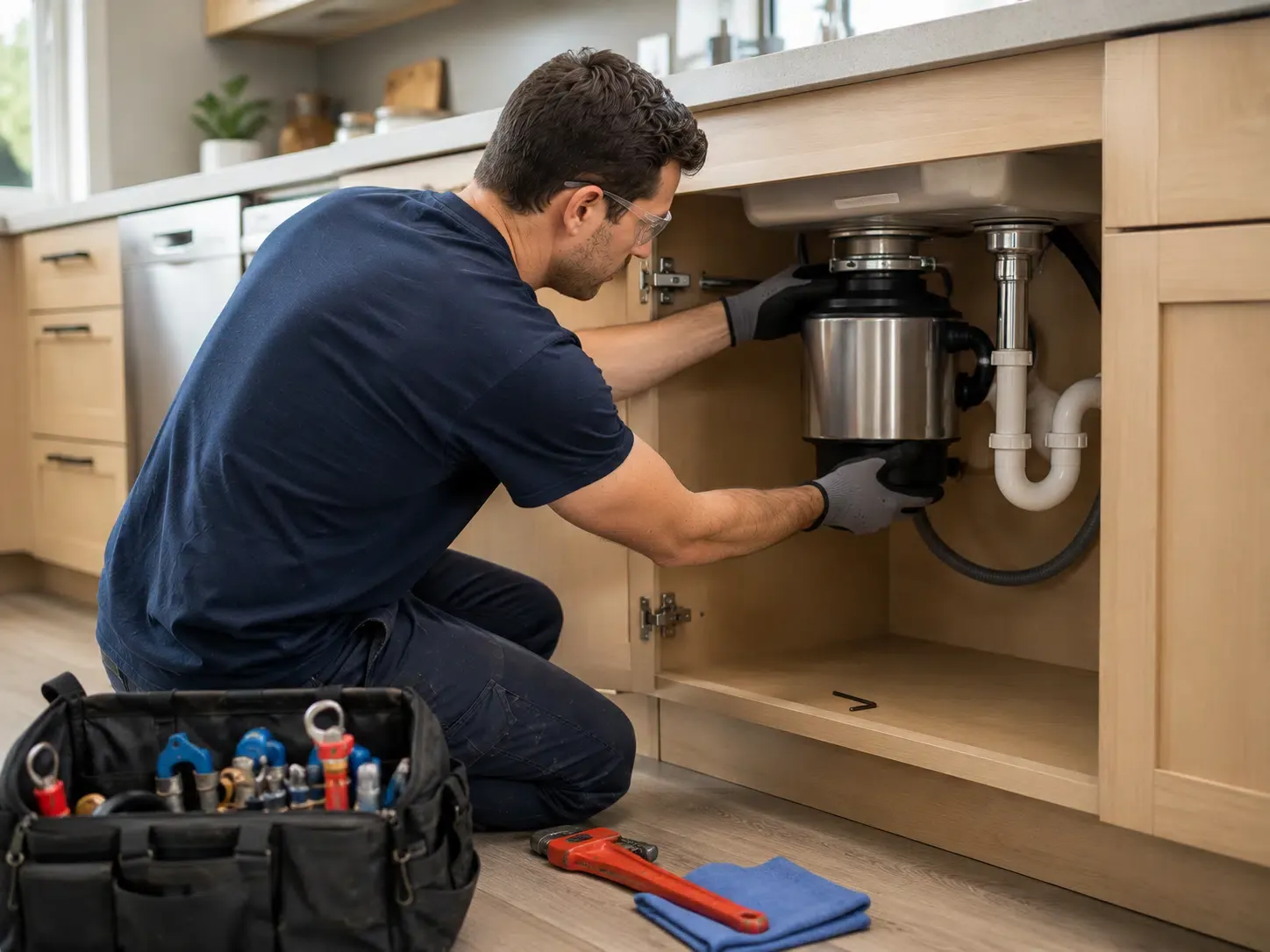
Try this first; it fixes most garburators for free
- Turn the power off. Switch the unit off at the wall, and if you are going to put anything into the chamber, switch off the breaker too. Never put your hand in a garburator, powered or not.
- If it hums but doesn’t turn, free the jam with the hex key. There is a hex socket in the centre underneath the unit, and most garburators ship with a small Allen key — usually 1/4 inch — often clipped to the housing or left under the sink. Insert it and work it back and forth. You will feel resistance, then a release when the plate frees.
- Remove whatever caused it with tongs, never fingers. It is usually a bone fragment, a fruit pit, a bottle cap or a piece of cutlery.
- Press the reset button. It is a small button, usually red, on the underside of the unit. It pops out when the motor overheats. Press it firmly until it clicks. Give the motor five to ten minutes to cool first.
- If it is completely silent, check the switch and the breaker. A dead unit with no hum at all is often a tripped breaker or a failed wall switch rather than a failed garburator. Check your panel first — it costs nothing.
- Run cold water and test it. Cold, not hot. Hot water melts fat and lets it re-set further down the line.
If it still hums after freeing the plate, still trips the reset repeatedly, leaks from the body of the unit, or does nothing with the breaker confirmed on, stop there. Those four symptoms are the ones worth calling about, and they are covered further down this page.
A garburator, the Canadian term for what is sold elsewhere as a garbage disposal, is an electric grinding unit fitted under the kitchen sink that reduces food scraps small enough to pass into the drain. Most faults are a jam or a tripped thermal reset, both of which the owner can usually clear. The faults that genuinely need a plumber are leaks from the unit body, repeated reset trips, a motor that will not turn after the jam is cleared, and drain or electrical problems the unit is only revealing.
VPS Vancouver Plumbing Services repairs, replaces and installs garburators in Vancouver, Downtown Vancouver, North Vancouver, West Vancouver, Burnaby and Coquitlam. We will tell you on the phone if what you are describing sounds like something you can fix yourself.
Not sure the quote you were given is right? Call (604) 603-3660
What Your Garburator Is Telling You
Garburator faults are unusually easy to read from the symptom. Here is what each one almost always means.
| Symptom | Most likely cause | Who fixes it |
| Hums but the plate does not turn | Something jammed between the impellers and the grind ring | You, with the hex key — plumber if it stays jammed |
| Completely silent, no hum | Tripped reset, tripped breaker, or failed wall switch | You first — electrician or plumber if power is confirmed |
| Trips the reset button repeatedly | Motor failing, or bearings worn | Plumber — usually replacement, not repair |
| Leaking from the sink flange at the top | Perished plumber’s putty or a loosened mounting ring | Plumber — often a reseal rather than a new unit |
| Leaking from the bottom of the unit | Internal seal failure — water is inside the motor housing | Plumber — this one is replacement |
| Leaking where the pipe joins the side | Loose discharge tube or failed gasket | Plumber — usually a small, cheap fix |
| Grinds but the sink will not drain | Blockage downstream of the unit, not the unit itself | Plumber — the garburator is fine, the drain is not |
| Loud metallic rattle | Cutlery, a bottle cap or a bone fragment loose in the chamber | You — power off, retrieve with tongs |
| Persistent smell | Build-up on the splash guard and grind chamber | You — clean the underside of the rubber splash guard |
| Slow, laboured grinding | Worn impellers, or the unit is undersized for the household | Plumber — a replacement conversation |
The pattern worth noticing: a leak from the top or the side is usually a repair, and a leak from the bottom is usually a replacement. Water inside the motor housing is not something to seal up and hope.
Repair or Replace?
Garburators are not expensive machines, and that changes the maths compared with most plumbing. There is a point where repair labour costs more than the unit is worth, and an honest plumber will tell you where that point is.
Worth repairing
- Leaks at the sink flange or the discharge connection — these are seals and fittings, not the machine.
- A jam that will not free with the hex key but comes out once the unit is opened.
- A failed wall switch or wiring fault — the garburator itself is fine.
- A blocked drain downstream that is making a healthy unit look faulty.
Worth replacing
- Water leaking from the bottom of the housing. The seal between the grinding chamber and the motor has gone and the motor is wet.
- Repeated reset trips after jams have been cleared, the motor is on its way out.
- A unit that is more than about ten to twelve years old and now failing. You will be back within a year.
- Grinding that has become slow and laboured, especially if the household has grown since the unit was fitted.
- Any unit where the repair labour approaches the cost of a new one, we will say so rather than bill you for the diagnosis and then again for the replacement.
If we arrive and the honest answer is that your ten-year-old unit is not worth the repair, that is what we will tell you, with the reason. You are free to disagree and ask us to repair it anyway.
Installing a Garburator: What Is Actually Involved
New installs and replacements are straightforward jobs, but there are four things that decide whether yours is simple or not, and they are worth knowing before you buy a unit online.
- Is there power under the sink? A garburator needs a dedicated switched outlet. In many older Vancouver kitchens there is no outlet under the sink at all, and that turns a plumbing job into an electrical one. This is the single most common surprise on a first-time install.
- Does your sink take one? Standard sinks have a 3.5 inch drain opening that suits most units. Some older or specialty sinks do not, and some composite sinks need particular care around the mounting.
- Is there room in the cabinet? Units vary considerably in height and diameter. A deep sink and a large unit together can leave nothing for the trap, and the trap arm has to keep its fall.
- Is there a dishwasher? If the dishwasher drains through the garburator, the knockout plug in the inlet has to be removed during installation. Forgetting it is the classic new-install fault: the dishwasher backs up on its first cycle and everyone blames the dishwasher.
Replacing like for like
Swapping an existing unit for a new one of similar size is usually a short job — the mounting assembly and the drain connections are already there. Where it stops being short is when the old mounting ring is corroded into place, or when the new unit is a different height and the trap has to be re-plumbed to keep its fall.
If you have already bought the unit
That is fine, and we will install it. We will also tell you before we start if it is the wrong size for your cabinet or the wrong fit for your sink, rather than discovering it halfway through with your kitchen out of action.
What Should Never Go Down a Garburator
A garburator is not a bin. Almost every jam we clear is one of the same short list.
- Fat, oil and grease. The single worst offender. It leaves the unit as a warm liquid and sets solid further down the line, where it catches everything else. Let it cool and bin it.
- Fibrous vegetables, celery, corn husks, artichoke, onion skins, asparagus. The strands wrap around the impellers instead of grinding.
- Starchy foods, pasta, rice, potato peel. They expand and turn to paste, and the paste sets in the trap.
- Coffee grounds. They pass the unit easily and then settle into a dense sludge downstream.
- Bones, fruit pits and shells. The classic jam.
- Contested, but the membrane wraps and the shell grit settles. Not worth it.
- Anything that is not food. Cutlery, bottle caps, twist ties, elastic bands off the broccoli.
Worth knowing: Metro Vancouver runs a food scraps recycling programme, and organics are subject to a regional disposal ban. Your green bin will take everything on the list above without complaint, and it will not jam.
Keeping it healthy
- Always run cold water while grinding, and keep it running for a few seconds after.
- Feed scraps in gradually rather than filling the chamber and switching on.
- Clean under the rubber splash guard regularly, that is where the smell lives, not in the chamber.
- Skip the caustic drain chemicals. They do not clear a jam and they are hard on the seals.
Are Garburators Being Banned in Vancouver?
This comes up a lot, and the honest answer is: a ban was proposed, and City staff recommended against it. Garburators remain allowed.
In July 2025, Vancouver City Council unanimously approved a motion from Councillor Pete Fry, titled “A Drain on Resources and Resources Down the Drain”; directing staff to draft policy that would ban garburators in new developments. The argument was that the units strain the sewer system, increase water use and add load at the treatment plant.
In December 2025, City engineering staff came back and did not recommend proceeding. Their analysis found the benefits would be negligible: a reduction in biological oxygen demand and suspended solids at the Iona Island treatment plant of about 0.17 percent, roughly $40,000 a year in savings across the regional district after a decade, and water savings equivalent to the annual consumption of three or four single-family homes after ten years. Staff also noted that a Vancouver-only rule would sit awkwardly against the surrounding municipalities and complicate development approvals.
So as things stand you can keep, repair, replace and install a garburator in Vancouver. If policy changes we will update this page, check the date at the top. For a definitive answer on your specific address or project, ask the City directly.
Our own position, for what it is worth: a garburator is a convenience, not a waste strategy. It handles plate scrapings well. It is not the right destination for a bag of vegetable trimmings, and the green bin is both cheaper and less likely to end with us under your sink.
How We Handle a Garburator Call
- You describe the symptom on the phone. If it sounds like a jam or a tripped reset, we will walk you through it there and then — no visit, no charge.
- If it needs a visit, we confirm a window and a fixed call-out arrangement before we come.
- On site we check the unit, the electrical supply and the drain downstream, because the garburator is often not the actual fault.
- We tell you what is wrong, whether it is worth repairing, and what we would do in your position.
- You get a fixed written price before any work starts.
- We carry out the repair or the replacement, test it under load, and check every joint for leaks.
- We clear up under the sink and leave the hex key where you can find it next time.
How We Price Garburator Work
We do not publish a rate for this, because the range is wide and the honest answer depends on what we find. A reseal at the flange, a jam we have to open the unit to clear, and a full replacement with new electrical are three very different jobs.
- You get one fixed written price before anything starts.
- If the unit is not worth repairing, we say so before you have paid for a repair attempt.
- If the fault turns out to be the drain rather than the garburator, we tell you that too, and quote the drain work separately so you can see what you are paying for.
- If it turns out to need an electrician for a new circuit under the sink, we will say so rather than improvising.
The variables are which fault it is, whether the unit is being repaired or replaced, whether there is a usable switched outlet under the sink, how accessible the cabinet is, and whether the visit is scheduled or out of hours.
Where We Work
BODY
VPS Vancouver Plumbing Services carries out garburator repair, replacement and installation throughout:
contact our team today for expert advice and professional installation.