
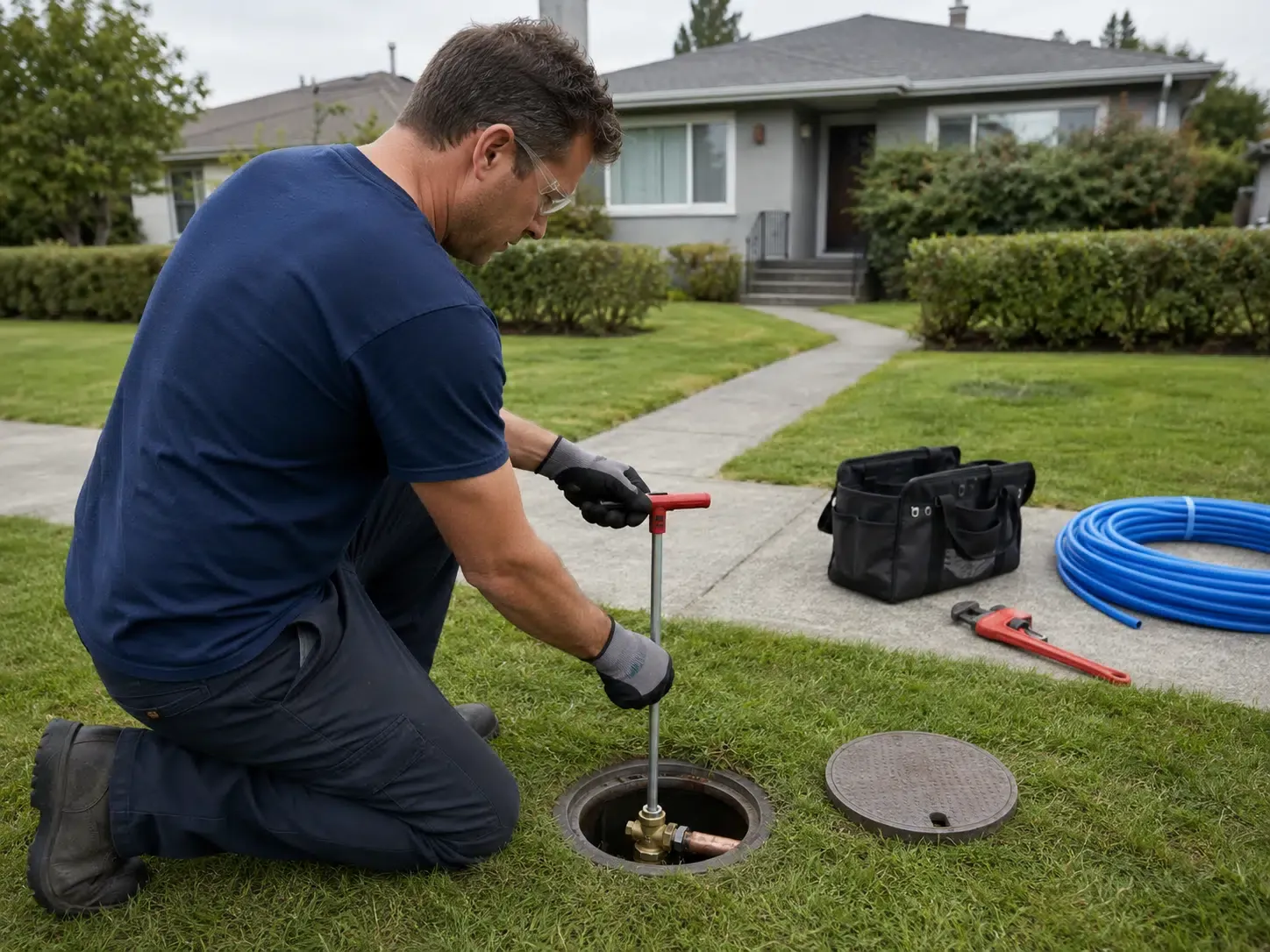
A wet patch in the lawn in August is one of the few plumbing problems where the first question is not what is broken but whose it is. The pipe running from the street to your house changes ownership partway along, and the two halves are paid for by two different people. Before you call anyone it is worth 10 minutes working out which half yours is in.
Whose pipe is it? Ten minutes, before you call the City
The City of Vancouver draws the line in a specific place. The City owns the shut-off valve at the property line, and the water line running from that valve out to the City main. Everything on your side of that valve, the buried run across your property and into the house, is yours.
- Find the valve. It sits at or near the property line, usually under a small metal or plastic lid set into the boulevard or the front lawn. That lid is the boundary. Water surfacing on the street side of it is a different conversation from water surfacing on the house side.
- Shut the main valve inside the house and watch the wet ground. If the water keeps coming with the house isolated, the leak is on the buried run outside, which, on your side of the property-line valve, is yours. If it stops, the leak is inside the house and this is not the right page.
- If you have a meter, use it. Turn off every fixture and appliance that uses water, then watch the meter for fifteen minutes. Any movement at all means water is going somewhere downstream of the meter. That is the cleanest test there is, and it works whether the leak is buried or inside.
Why this is worth doing first: the City will attend and determine which side the leak is on, but if it turns out to be on your side you are invoiced for the visit. The City’s published rates are $126 per hour during regular hours, Monday to Friday, 7am to 3:30pm; and $252 per hour after hours, on weekends and on holidays. The City also states plainly that it does not repair water leaks on private property. Narrowing it down before you call is worth real money.
Quick Summary
Water main replacement means renewing the buried service line that carries pressurised drinking water from the shut-off valve at your property line into the house. It is replaced rather than patched when the pipe is corroded galvanized steel, when copper has started leaking repeatedly, or when a single leak sits under something expensive to open twice.
VPS Vancouver Plumbing Services replaces and repairs water service lines in Vancouver, Downtown Vancouver, North Vancouver, West Vancouver, Burnaby and Coquitlam, for homes, strata properties and commercial buildings.
The Line That Decides Who Pays
Almost every water main page in this city opens with the word trenchless. That is a method. The question homeowners actually arrive with is a money question, so here it is properly.
The City of Vancouver owns the shut-off valve at the property line and the pipe from that valve to the City main under the road. If a leak is on that portion, and no earlier work has damaged the system, the City covers the repair. Everything from the valve inward belongs to the property owner, and the City states directly that it does not repair water leaks on private property.
Two things follow from that, and both are worth knowing before anyone digs.
- A visit is not free if the leak turns out to be yours. The City publishes its rates: $126 per hour in regular hours, Monday to Friday 7am to 3:30pm, and $252 per hour outside them, including weekends and holidays. If the source is determined to be on your side of the valve, you are invoiced for the attendance.
- The location of the wet ground is a clue, not a verdict. Water travels along the outside of a buried pipe and along the trench that was dug for it, and it surfaces wherever the ground lets it. A leak on the City side can appear in your lawn, and a leak on your side can appear near the boulevard. This is exactly why the meter test and the house-isolation test matter more than where the puddle is.
The other municipalities we work in draw the boundary in a broadly similar place, but the exact wording and the rates differ. If you are outside Vancouver, check your own municipality’s water regulations rather than assuming Vancouver’s figures apply to you; and we will tell you what we find on site either way.
What the Symptoms Actually Mean
The service line gives fewer warnings than anything else in a house, and the ones it gives are easy to attribute to something else.
| What you are seeing | Usually means | What to do |
| Wet patch or unusually green grass in dry weather | A buried leak somewhere along the run | Do the meter test before calling anyone |
| Sound of running water with every tap off | Water is moving somewhere it should not be | Meter test; this is the classic sign |
| Pressure has faded at every fixture over years | Galvanized steel corroding closed from the inside | Replacement, not repair; see below |
| Pressure dropped suddenly everywhere | A leak, or a partly closed valve on the run | Check the main valve is fully open first |
| Rusty or brown water on the first draw of the day | Galvanized pipe shedding scale | Replacement, no repair fixes this |
| Water bill jumped with no change in habits | A buried leak on a metered property | Meter test, then call |
| Water pooling at the curb or in the boulevard | Possibly the City side, but see the note above | Test first, then report |
| Soft ground, a dip, or a sinkhole along the run | Water washing soil out around the pipe | Do not wait on this one |
| Repeated pinhole leaks in the same run of copper | The whole run is at the same age and condition | Replacing beats patching a fourth time |
| No water at all, neighbours are fine | Service line, valve, or a frozen section in winter | Call, this one is same-day |
| Grey plastic pipe cracking at fittings inside the house | Poly-B, a repipe, not a service line job | Different job, see below |
| Weak flow at one fixture only | Not the service line at all | That is a faucet or aerator problem |
What Your Service Line Is Probably Made Of
The age of the house is the strongest single predictor, and it changes whether you are looking at a repair or a replacement.
Galvanized steel: the one that never gets repaired
Common in older Vancouver and North Shore housing. Galvanized pipe corrodes from the inside out, and the corrosion narrows the bore before it ever produces a leak. That is why the symptom sequence is so distinctive: pressure fades gradually across the whole house over years, discoloured water appears on the first draw of the morning, and only much later does a pinhole open.
There is no version of this that is worth repairing. Patching one hole in a pipe that has been closing up for fifty years buys a few months. If the diagnosis is galvanized, the honest recommendation is replacement, and any contractor offering to repair it is selling you a return visit.
Copper: repairable, until it is not
Copper service lines last a long time and a single leak in an otherwise sound line is a legitimate repair. The judgement call is repeat failures. When a second and third pinhole appear in the same buried run, they are telling you the whole length is at the same age, in the same soil, carrying the same water. At that point the third patch costs more than the replacement, once you count opening the ground three times instead of once.
Plastic: and the pipe people confuse it with
Newer service lines are usually a flexible plastic pulled through in one continuous piece with no buried joints, which is exactly why they fail so rarely. When they do it is almost always mechanical — something dug into it — rather than age.
This is where a common confusion needs clearing up. Grey plastic pipe with plastic fittings running through the walls and ceilings inside a house is Poly-B, and it is a different subject entirely. Poly-B was installed in Canadian homes from roughly 1978 into the late 1990s, becomes brittle with age, and typically fails at the fittings rather than along the pipe. Insurers in British Columbia have been tightening their position on it. But Poly-B is interior plumbing, not the buried service line, and replacing it is a repipe rather than a water main replacement. If that is what you have, say so when you call so we send the right crew and the right quote.
Trenchless or Open Trench? and Why Water Is Not Sewer
Trenchless is the word every competitor leads with, so it is worth being precise about what it means on a water line specifically, because it is not the same set of options you get on a sewer.
A sewer line can often be relined, a new pipe cured in place inside the old one, because it is a gravity drain that only has to be watertight and correctly sloped. A pressurised drinking water line cannot be treated that way. It has to hold pressure continuously and it has to be certified for potable water, so the trenchless option here is not lining. It is replacement in place.
Pipe bursting
A head is drawn through the old pipe, splitting it outward into the surrounding soil while pulling the new line in behind it. It needs a pit at each end and nothing in between, which is why it is the method of choice when the run passes under a driveway, a paved path, mature planting or a tree with roots you would rather not cut.
It is not universally available. The old pipe has to be in a condition that will burst rather than collapse ahead of the head, the soil has to accept the displacement, and the route has to be clear of other services, gas, electrical, communications, at the depth being worked. Any contractor who quotes trenchless before locating what else is buried along that route is quoting a hope.
Open trench
Sometimes the right answer. If the run is short, if it crosses open lawn, or if the route has to change because the original line took a path nobody would choose today, digging it is faster, cheaper and lets everything be inspected as it goes in. Open trench also stops being a disadvantage when the surface above it is grass rather than stamped concrete.
The honest version: trenchless saves the surface, not necessarily the money. On a run under a lawn the two methods often land close together, and we will say so rather than charging a premium for a word.
The two steps a water line needs and a sewer does not
Whichever method is used, a new potable service line is pressure tested before it is buried or put into service, and it is disinfected and flushed before it carries drinking water. These are not optional and they are not extras. If a quote does not mention them, ask.
When It Is Not a Water Main Replacement
This page covers one specific pipe. Several problems that feel identical belong elsewhere, and sending you to the right one is more useful than taking the booking.
- A pipe has burst inside the house. Shut the water off and call. That is our burst pipe repair service page, and it is an emergency rather than a planned replacement.
- You can see the leak but not where it starts. Locating a hidden leak is its own service; see our water pipe leak detection page.
- The leak is in a plastic pipe you can reach. Our guide on stopping a leak from a plastic pipe covers what holds and what does not, including what tape will and will not do.
- The shut-off valve itself is the problem. A valve that will not close or has started weeping is a valve repair; see our water shut-off valve page.
- Pressure is poor everywhere but nothing is leaking. Read our article on why your water pressure is low first. It may still end up here, but it may not.
- The grey plastic pipes inside the house are the problem. That is a Poly-B repipe. Tell us when you call; it is a different crew and a different quote.
- It is the drain rather than the supply. Waste leaving the house is a separate system. Start at our drainage and sewer services page.
How the Job Runs
- We confirm which side of the property line the problem is on, because that decides whether this is your job at all. If it is the City’s, we tell you and you do not pay us to replace their pipe.
- We establish what the existing line is made of and where it runs. Material decides repair versus replacement; route decides trenchless versus open trench and what is at risk above it.
- We locate the other services along the route before committing to a method. Gas, electrical and communications at working depth are the reason a trenchless quote given over the phone is not a real quote.
- You get one fixed written price, with the method named and the reinstatement stated; what gets put back, and to what standard. Surface reinstatement is the item most commonly left vague in this trade, so we put it in writing.
- We handle the municipal side. Work at the service connection involves the City, and we deal with that rather than leaving you to.
- The new line goes in, gets pressure tested, and is disinfected and flushed before it supplies the house. Then the ground goes back.
What Water Main Replacement Costs in Vancouver
No plumber in this city publishes a number for this job, and for once that is defensible rather than evasive; the variables are genuinely large. What is not defensible is refusing to explain them, which is what every competitor page does. So here is the structure.
- Length of the run. The distance from the property line to where the pipe enters the house. A deep lot with a long setback is a different job from a townhouse.
- What is on top of it. This is usually the biggest single factor and it has nothing to do with plumbing. Lawn is cheap to reinstate. A stamped concrete driveway, a paved walk, a retaining wall or a mature tree is not, and it is what pushes a job toward trenchless.
- Depth and ground conditions. Rock, a high water table, or a run that has to be dug by hand because of what else is buried there all change the day.
- Trenchless costs more in equipment and less in reinstatement. Which one wins depends entirely on the point above, which is why we quote it after looking rather than before.
- Whether the connection at the property line needs work too. Sometimes the valve and the connection are as old as the pipe.
One published figure is worth knowing because it can land on your bill before any plumber is involved. The City of Vancouver charges $126 per hour in regular hours and $252 per hour after hours, on weekends and on holidays, when it attends and the leak turns out to be on the private side. That is the City’s own published rate, and it is the reason the first section of this page is a free test rather than a phone number.
What we commit to is a fixed written price after we have seen the site, with the method and the reinstatement standard named in it, approved by you before any ground is opened.
Where We Work
Water service line replacement across Vancouver, Downtown Vancouver, North Vancouver, West Vancouver, Burnaby and Coquitlam.
- Vancouver and Downtown Vancouver. The municipality with the clearest published position on where its responsibility ends, and the one whose rates are quoted above. Older east and south Vancouver housing is where galvanized service lines still turn up.
- North Vancouver and West Vancouver. Sloped lots, long setbacks and rock. Both raise the cost of an open trench and both are arguments for locating everything properly before choosing a method.
- Post-war housing with original service lines alongside recent development. Two different jobs in one municipality, and the age of the house tells you which.
- Newer stock where a service line failure is far more often mechanical damage than age; which changes the diagnosis and sometimes changes who is responsible for it.
Boundaries and rates differ by municipality. The figures quoted on this page are the City of Vancouver’s published ones; outside Vancouver we confirm the local position rather than assuming.