
Sewage coming up through the basement floor drain? Toilet backing up every time the washing machine empties? Take a breath, you’re in the right place, and this is fixable. A sewer backup is not a normal clog the blockage sits downstream of everything, so the whole house has nowhere to drain. Nobody wants to deal with this at 11pm on a Sunday, and nobody should be cleaning it up barehanded.
Main Sewer Line Backups
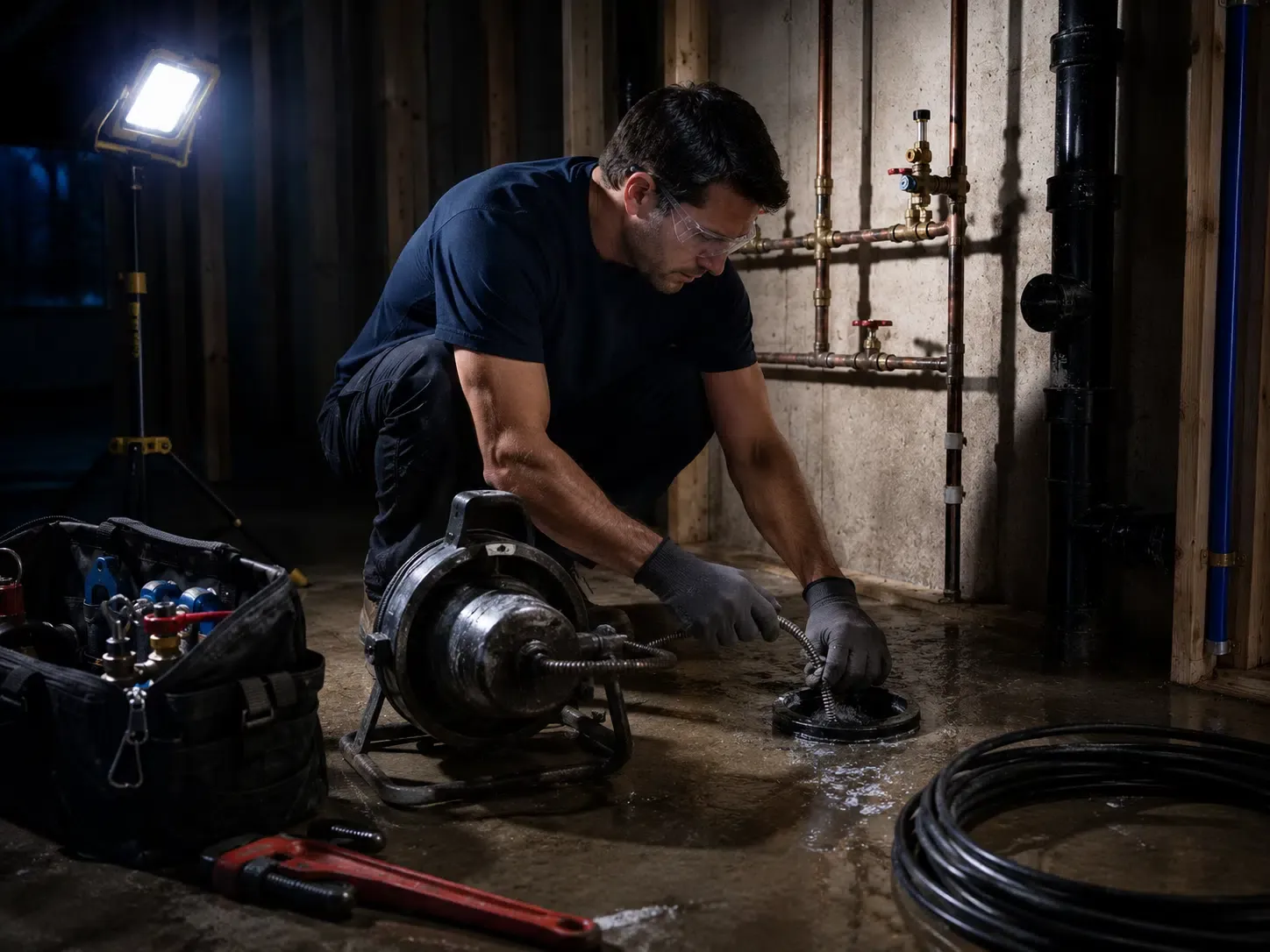
Most full-house backups start in the main sewer line — the single pipe carrying everything to the city connection. Roots, grease and collapsed sections choke that line until the lowest drains in the house back up first. We clear main sewer lines with the right cutter or jetter, then run a camera down the line so you see the cause, not just the symptom.
Book a Sewer Backup Callout
A sewer backup happens when the drain line carrying waste away from your property is blocked or overwhelmed, so sewage flows back into the building through the lowest opening usually a basement floor drain, a ground-floor toilet or a laundry standpipe. It is a plumbing emergency and a health hazard: the IICRC S500 standard classifies sewage backflow as Category 3 water, defined as grossly contaminated and capable of causing serious illness. It needs a licensed plumber, not a plunger.
VPS Vancouver Plumbing Services responds to sewer backups 24 hours a day across Vancouver, North and West Vancouver, Burnaby, Coquitlam, Richmond, Surrey and the rest of the Lower Mainland, for houses, strata buildings and commercial properties. We locate and clear the blockage, camera the line to find out why it happened, and give you the footage and written report your insurer will ask for.
Licensed, insured and answering 24/7 – call (604) 603-3660 and you’ll get a fixed price in writing before we pick up a tool, not a surprise on the invoice after.
Do this right now, before anyone arrives
- Stop using water everywhere in the building. Every flush, tap and appliance cycle adds to what is already coming up. Tell everyone in the house, and shut off the dishwasher and washing machine mid-cycle if they are running.
- Keep people and pets out of the affected area. Children, older adults, pregnant people and anyone with a weakened immune system should not be in the space at all.
- Do not walk through it. If you have to cross it, wear rubber boots and gloves, and wash thoroughly straight after. Do not touch your face.
- Treat electricity as the first danger. If water has reached outlets, cords or the panel, do not enter the room. Only shut the power off if you can reach the panel without standing in water. If you cannot, stay out and call an electrician or BC Hydro.
- Ventilate if it is safe to do so. Open windows in the affected area and close the door to the rest of the house.
- Do not pour bleach or drain chemicals into it. They will not clear a main-line blockage, and they make the water more dangerous for anyone who has to work in it afterwards.
- Photograph and video everything before you move or clean anything. Your insurer will want to see the extent of it. This is the single step people most often skip and most often regret.
- Call a 24/7 plumber to stop the source, then call your insurer to open a claim. In that order. Until the blockage is cleared, the backup can happen again the moment anyone upstairs runs a tap.
How to Tell a Sewer Backup From an Ordinary Clog
This distinction matters, because it changes who you call and how urgent it is. A single blocked fixture is a local problem. A backup means the main line is blocked and every drain in the building is affected.
| Ordinary fixture clog | Sewer backup (main line) | |
| How many fixtures affected | One | Two or more, usually the lowest ones first |
| Where water appears | In the blocked fixture only | Basement floor drain, ground-floor toilet, shower base, laundry standpipe |
| What triggers it | Using that fixture | Using any fixture — flushing upstairs can back up the basement |
| Smell | Localised, mild | Strong sewage odour through the lower floor |
| Sound | Gurgle at that drain | Toilet bubbles or water level moves when a sink or washer drains |
| What the water looks like | Grey, soapy | Dark, cloudy, may contain solids and paper |
| Right response | Plunger or a plumber in the morning | Stop all water use and call a 24/7 plumber now |
The clearest single test: flush an upstairs toilet and watch the basement floor drain. If water rises there, the blockage is in the main line and everything upstream of it is now draining into your basement.
Why Sewage Is Treated Differently From Clean Water
Restoration professionals classify water damage in three categories under the IICRC S500 standard. Category 1 is clean water from a supply line. Category 2 is used water from a dishwasher or washing machine. Category 3 — the standard’s term is grossly contaminated, and it is capable of causing serious illness — includes sewage backflow, toilet overflow containing waste, and ground-source flooding.
Two things follow from that classification, and both cost people money when they find out late.
- Porous materials that absorbed the water are generally removed, not dried. Under the standard, that means affected drywall, insulation, carpet and underlay come out. Hard surfaces can be cleaned and treated with an antimicrobial. Trying to dry out contaminated carpet to save money usually ends with removing it later anyway, after it has been sitting.
- Category 2 water becomes Category 3 within roughly 48 to 72 hours of sitting. A washing-machine overflow you leave over a long weekend is a different, more expensive problem by Tuesday. Speed genuinely changes the scope of work here — this is not an upsell, it is how the standard defines it.
What not to do
- Do not run a household wet-vac or shop vacuum through sewage and then use it elsewhere in the house.
- Do not put fans or a dehumidifier on it before the contaminated material is removed — you are moving contaminated aerosols around the building.
- Do not attempt to clean it yourself without proper gloves, boots, eye protection and a respirator, and do not let anyone vulnerable near the area.
- Do not throw anything out before it is photographed and your insurer has been notified.
What Causes Sewer Backups in Vancouver Homes
Tree roots in the lateral
The most common cause in older Vancouver neighbourhoods. Mature street trees find hairline gaps at clay or cast iron joints and thicken inside the pipe where the water is. Roots catch paper and solids until the line closes entirely. Kitsilano, Mount Pleasant, Grandview-Woodland, Dunbar and much of the East Side sit on exactly this combination of old laterals and large trees.
Grease and solidified fat
Cooking fat leaves the sink warm and sets hard a few metres down the line, building in layers until the bore closes. This is the leading cause in commercial kitchens and a common one in shared residential stacks. Metro Vancouver reports that clearing this build-up from the regional sewer system costs over $2.7 million each year.
Wipes and non-flushables
So-called flushable wipes do not break down. In apartment and strata buildings they are a leading cause of main-stack blockages, because one unit’s habits back up into a neighbour’s bathroom.
Heavy rain and combined sewers
Parts of Vancouver still run on combined sewers that carry sewage and rainwater in the same pipe. In sustained heavy rain the system can surcharge, and the pressure looks for the lowest opening which may be your basement. The City of Vancouver is progressively separating these systems as part of the Province of British Columbia’s goal to eliminate sewage overflows by 2050, but until your street is done, a wet-weather backup is a real risk in a low-lying property.
A collapsed, cracked or bellied lateral
An old pipe that has sagged, cracked or lost its shape will keep backing up no matter how many times it is cleared. Orangeburg, a bituminised wood-fibre pipe manufactured until the company closed in 1974, was rated for about 50 years and has been recorded failing in as little as 10. If your property is of that era and backs up repeatedly, the camera usually finds a structural failure rather than a blockage.
A blockage in the City main
Sometimes the problem is not on your property at all. This matters for who pays, and it is covered in the next section.
Who Is Responsible? You or the City of Vancouver?
This is the question every homeowner asks and almost no plumbing website answers honestly. Here is what the City of Vancouver actually publishes.
The property owner is responsible for what is discharged into the sewer lateral from the building through to the City’s sewer main. When a blockage occurs, the City’s position is that the cause determines responsibility, not the location and where the cause cannot be determined, responsibility defaults to the property owner.
That single rule is why camera evidence matters so much. If the footage shows roots from a City street tree, a failure in the City’s main, or a defect outside your property line, you have something concrete to bring to the City and to your insurer. Without footage, an undetermined cause becomes your bill by default.
The City also publishes what it charges when it attends. As of the City’s current schedule, sewer service calls are billed hourly: roughly $138 to $718 during regular hours (Monday to Friday, 7:00am–3:30pm), $139 to $727 after hours on weekdays, and a minimum of about $538 as a two-hour flat rate overnight, on weekends and on holidays. Someone with authority for the property has to be present to sign the service agreement, which commits the owner to pay if the blockage turns out to be their responsibility. Confirm current figures with the City before relying on them.
Read that last part carefully before you sign anything at 2am.
Will Insurance Cover a Sewer Backup?
Usually only if you specifically bought the coverage. Standard home insurance policies in Canada do not include sewer backup — it is sold as an optional endorsement you have to ask for. Industry figures put that endorsement in the range of roughly $150 to $300 a year, rising toward $700 in areas with frequent claims.
The exposure is worth understanding before you decide. Sewer backup remediation is commonly estimated at $7 to $14 per square foot of affected area, with most claims landing between $2,000 and $10,000 and severe cases running past $50,000. Those are Canada-wide industry figures, not Vancouver-specific, so treat them as a scale rather than a quote.
Two conditions catch people out:
- Some BC policies require a backwater valve to be installed before sewer backup coverage applies. Check the wording of your own policy , if a valve is a condition and you do not have one, the endorsement may not pay.
- Insurers can decline where damage resulted from deferred maintenance. A line that had been backing up for months without action is a different conversation from a sudden failure. Dated camera footage and job records from previous visits are what settle that argument.
What we give you for the claim
- Before-and-after camera footage of the line, recorded and timestamped
- A written report describing the cause and the work performed
- The itemised invoice your adjuster will ask for
We are plumbers, not insurance advisers, and nothing here is a coverage opinion — confirm your own position with your broker. What we can do is make sure you are not arguing your case without evidence.
What Happens When We Arrive
- We make the area safe and confirm no water use is running anywhere in the building.
- We locate the cleanout and open the line to relieve the backup, stopping more sewage entering the building is the first priority, before any diagnosis.
- We clear the blockage using the method the line calls for: augering for a solid obstruction, hydro jetting where grease, roots or scale are coating the pipe wall.
- We camera the full run and record it, so we can see whether this was a one-off blockage or a structural failure that will repeat.
- We show you the footage on site and explain what it means in plain terms including if the honest answer is that the pipe needs repair rather than cleaning.
- We give you one fixed written price for any further work before it starts.
- We send you the footage, the written report and the invoice for your insurance claim.
Where our work ends and restoration begins
It is worth being clear about scope. We are the plumbing side of this: stopping the backup, clearing and diagnosing the line, and repairing or replacing the pipe. Remediation of Category 3 contamination removing affected drywall, insulation, carpet and underlay, then decontaminating and drying the structure is specialist restoration work, and on a significant loss your insurer will usually appoint a restoration contractor directly.
We will tell you honestly which of the two you need, and often you need both. A plumber who offers to dry out a sewage-soaked basement is working outside their trade.
Stopping It From Happening Again
Backwater valve
A backwater valve sits in the main line and closes automatically when flow tries to reverse, so sewage from a surcharged municipal system cannot enter the building. It is the single most effective protection for a property with basement fixtures or one that sits lower than street level. Some Metro Vancouver municipalities now require one on new construction or major renovations, and as noted above, some insurance policies make it a condition of coverage, confirm both with your municipality and your broker for your specific address.
A valve is not fit-and-forget. It needs inspecting at least annually, with debris cleared from the flap so it can seat properly. A valve jammed open by a wipe protects nothing.
Know your pipe before it fails
If your property predates 1970, a single camera inspection tells you what you are dealing with material, condition, root entry points, grade, and turns an unknown into a maintenance plan. It is a great deal cheaper than finding out during a rainstorm.
Routine habits that actually matter
- Never pour cooking fat, oil or grease down a sink. Let it set and bin it.
- Flush nothing but waste and toilet paper, no wipes, cotton products, floss or paper towel, whatever the packet says.
- Fit mesh strainers on kitchen and shower drains and empty them regularly.
- If you have mature trees near the lateral, schedule a camera check on a set interval instead of waiting for a backup.
- Have the main line jetted every 18 to 24 months in a typical home, and far more often for a commercial kitchen.
- Keep every invoice and inspection report. It is your maintenance record if a claim is ever questioned.
Strata Buildings and Commercial Properties
A backup in a multi-unit building is a different job. The blockage is usually in a shared stack or the building main, the damage crosses unit boundaries, and responsibility has to be established between owner, strata and insurer before anyone can proceed.
- We attend 24/7 and work with strata councils and property managers on access, resident notice and shared-stack diagnosis.
- Camera footage and a written report per visit, suitable for the strata’s records and for apportioning responsibility between the corporation and an individual owner.
- For commercial kitchens we can also schedule jetting of the runs a grease interceptor pump-out does not touch the pipework between fixtures and interceptor, and between interceptor and the city main.
- Out-of-hours attendance so a restaurant or retail floor is not shut down during trade.
If you operate a food service business in Metro Vancouver, note that the grease interceptor bylaw requires the interceptor to be pumped every 90 days, or whenever fats, oils, grease and solids exceed 25% of total liquid depth whichever comes first, with records kept of every cleanout. A backup traced to a neglected interceptor is both a repair bill and a compliance problem.
How We Price Emergency Sewer Backup Work
We do not quote a backup over the phone. Until the line is opened and cameraed, nobody knows whether this is a blockage to clear or a failed pipe to replace, and a number given before that is a guess that gets revised upward on site.
- We attend, make the situation safe and stop the backup first.
- We camera the line and show you what caused it.
- You then get one fixed written price for the remaining work, approved by you before it starts.
- If the camera shows the cause sits with the City or outside your property line, we document it so you can take it up rather than absorb it.
What moves the price: how accessible the cleanout is, the length and material of the run, whether the blockage clears with an auger or needs jetting, whether the pipe is structurally sound, and whether the call is during business hours or overnight.
Areas We Serve
VPS Vancouver Plumbing Services proudly provides Sewer Backup and plumbing services throughout:- Vancouver
- North Vancouver
- West Vancouver
- Burnaby
- Coquitlam
If your water heater has failed or is nearing the end of its lifespan, contact our team today for expert advice and professional installation.