
- Vanco Plumbing Team
- October 1, 2026
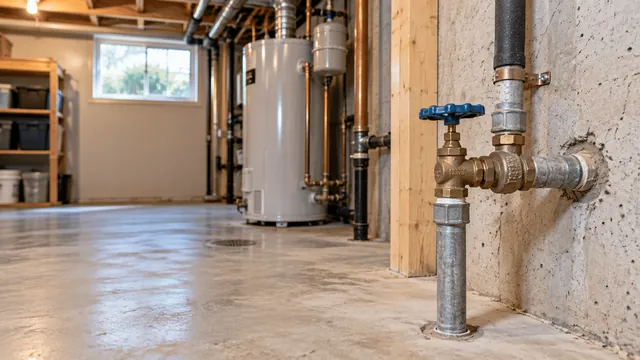
In a house, look near the point where the water supply enters the building—often in a basement, crawl space or ground-floor utility area. In a condo, look for a labelled suite shut-off in a plumbing access panel or utility space, and ask your building manager if you cannot identify it. A townhouse may have either an individual shut-off or a shared supply arrangement.
There is no single valve location that fits every Vancouver home. Renovations, additions and building layout can change where you need to look. A valve beside the water heater or under a sink is not automatically your main shut-off. For the City of Vancouver’s distinction between the indoor supply and the exterior curb stop, see its official water-service shut-off guidance.
Water leaking right now? Close a clearly identified fixture or home shut-off only if you can reach it safely. Do not enter standing water near electrical equipment or touch wet switches. If you cannot isolate the leak, request emergency plumbing help and, in a strata building, contact the building’s emergency contact. Leave an unsafe area; call 911 for immediate danger.
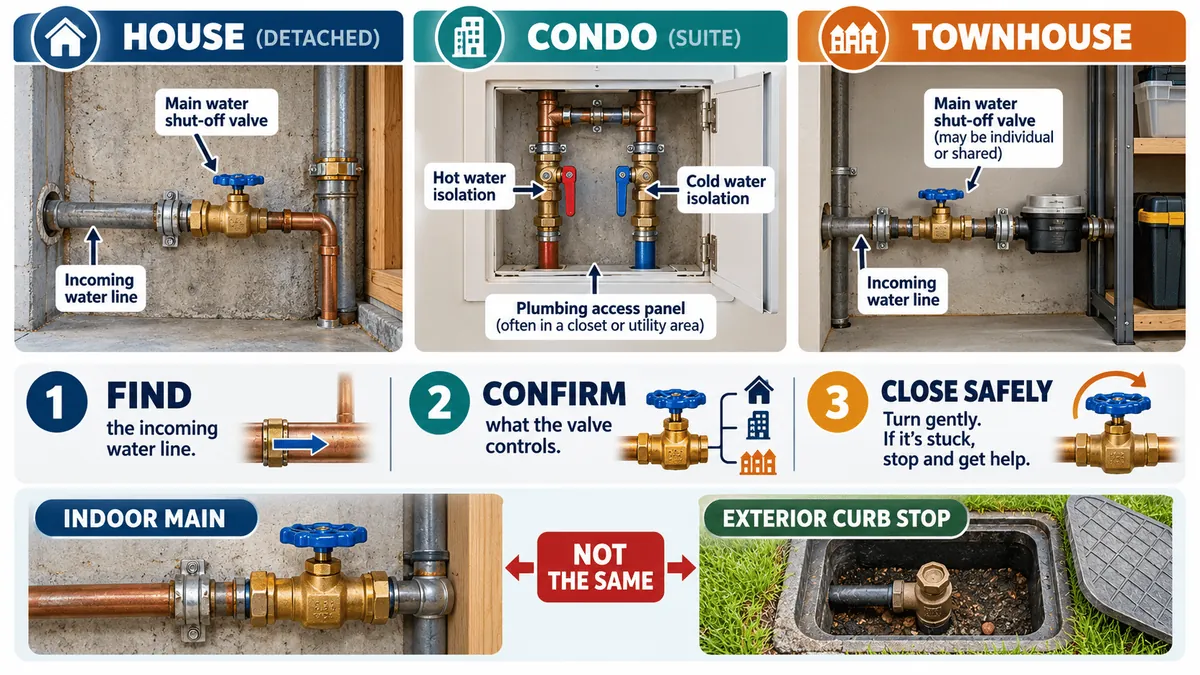
Where to look: house, condo and townhouse locations
| Home type | Start your search here | What to confirm |
|---|---|---|
| Detached house | Basement or ground-floor utility area, close to where the water service enters through the foundation. Check accessible panels, storage areas and under stairs. | The valve is upstream of the branches serving the home, not just one fixture or the water heater. |
| House with a crawl space | An accessible hatch or service area near the incoming water line. | Do not enter a flooded, unsafe or difficult-to-exit crawl space. Arrange help if access is unsuitable. |
| Condo | A labelled plumbing access panel, utility cupboard or documented suite shut-off location. A panel may be near a bathroom, kitchen or laundry area. | Whether your suite has separate hot- and cold-water shut-offs, and whether the valve affects only your suite. |
| Townhouse | Garage, utility cupboard, basement or incoming service area; consult the strata’s building information. | Whether the valve isolates your home or a shared section of the complex. |
| House with a secondary suite | The main building service entrance and any labelled suite isolation valves. | A suite valve may not stop water elsewhere in the house. Tell other occupants before a planned shut-off. |
Previous owners, landlords, building staff and plumbing records may help locate the valve. Treat an old label as a clue, not proof: have an uncertain valve identified before relying on it. If the valve is stuck, leaking or unreliable, see our water shut-off valve repair service rather than forcing the handle.
Finding the main shut-off in a Vancouver house
Trace the incoming cold-water service
Start with accessible utility spaces at the lowest level of the house. Look for a water pipe entering through the foundation or floor and follow it toward the distribution piping. The main isolation valve should control the supply before it branches to fixtures. Pipe size alone does not establish which valve is the main.
The street-facing side can be a useful starting point, but do not assume the connection follows the shortest route from the street. Corner lots, older alterations and additions may have different arrangements. If the pipe disappears behind a finished wall, look for an existing access panel rather than cutting into the wall.
For the exterior connection, consult the City’s water-service connection location guide. Vancouver also publishes shut-off-key instructions for eligible exterior services. These resources concern outside equipment, not proof of your indoor valve’s location. Confirm the appropriate procedure with the City before attempting to operate an unfamiliar curb stop.
Do not confuse the water-heater inlet with the house main
A valve on the cold-water pipe entering a water heater normally controls the heater’s incoming supply. It does not normally isolate the home’s cold-water taps. Likewise, a small valve under a sink generally serves that fixture, not the whole house.
A main shut-off may happen to be near the water heater, but location alone is not enough to identify it. If the piping is unclear, ask a plumber to trace and label it.
Finding the water shut-off in a Vancouver condo
Ask about both hot and cold water
Some buildings provide centrally heated hot water. Your suite may therefore have separate hot- and cold-water supplies, with separate isolation valves. Closing only the cold-water valve may not stop a hot-water supply leak. Other suites have their own water heater and a different arrangement.
Check the building’s resident information and labelled access panels. A pair of valves under a sink may serve only that sink; do not assume they isolate the suite. Ask building management to confirm the shut-off locations and what each controls.
Contact building management for ceiling leaks and shared piping
Water entering through a ceiling or shared wall may originate in another suite or a common pipe. Your own shut-off may have no effect. Notify the building emergency contact promptly and explain where water is appearing, whether it is still flowing and whether other units may be affected.
Do not operate riser valves, sprinkler valves or equipment in a shared mechanical room yourself. A building-wide shutdown needs coordination. The location of a valve does not, by itself, determine ownership, repair responsibility or insurance coverage; those questions depend on the building’s documents and circumstances.
Finding the shut-off in a townhouse or rental home
A townhouse with an individual service can resemble a detached house, with its shut-off in a garage, basement or utility area. Another townhouse may share supply infrastructure with neighbouring homes. Confirm the arrangement with the strata manager rather than using a neighbour’s layout as a guide.
If you rent, ask your landlord or property manager to show you the appropriate valve before there is a leak. During an active leak, do not delay reporting it while searching. Use an accessible, clearly identified local valve if safe, and notify the landlord and building emergency contact as applicable.
What does a water shut-off valve look like?
| Handle | Usual closed position | Safety limit |
|---|---|---|
| Lever on a ball valve | A quarter turn places the handle across the pipe. Parallel to the pipe usually means open. | Use hand pressure only. Stop at the designed stop; do not force it further. |
| Round wheel on a multi-turn valve | Gently turning clockwise closes it; several turns may be needed. | Stop if it is seized, starts leaking or causes the pipe to move. Do not overtighten. |
| Unfamiliar, concealed or key-operated fitting | Operation depends on its design and purpose. | Do not guess. Have the fitting identified and confirm authorization before operating it. |
Handle colour is not a reliable guide. Similar handles can appear on gas, heating and fire-protection systems. If you cannot positively identify the water supply, stop and get assistance.
Which valve should you use when something leaks?
| Situation | Appropriate first action | If that does not work |
|---|---|---|
| Toilet supply hose or cistern leak | Close the accessible toilet supply valve, often near the wall or floor beside it. | Use the confirmed home or suite shut-off and arrange repair. |
| Sink supply hose leak | Close the appropriate under-sink supply valve if safely reachable. | Close both local supplies if the source is uncertain, or use the confirmed main. |
| Washing-machine supply hose leak | Use the appliance water valves if accessible without moving equipment into water or touching wet electrics. | Use the confirmed main; keep clear of electrical hazards. |
| Water pipe leaking inside a wall | Close the confirmed main or relevant suite supply. | Call a plumber; alert building management in a strata property. |
| Water entering from the suite above | Contact the building’s emergency contact immediately. | Building staff need to coordinate isolation of the actual source. |
| Drain or sewer backing up | Stop using plumbing fixtures and water-using appliances; request drainage help. | Shutting your supply does not stop sewage or water arriving through a shared drain. |
If the source is unclear, see our water-pipe leak repair and detection service. A shut-off limits incoming water; it does not repair the fault or remove water already trapped in a pipe, tank, wall or ceiling.
How to confirm the water is off without making the problem worse
After gently closing a confirmed supply valve, briefly open a cold-water tap at an undamaged sink with a functioning drain. Residual water may run before slowing and stopping. Avoid this check if there is a drainage backup or using that fixture could add to the damage.
A continuing steady flow may mean the valve is not closing fully, the wrong valve was operated or another supply remains open. In a condo with separate supplies, testing a cold tap says nothing about whether the hot supply is isolated. Do not keep tightening an old valve to make it stop.
Keep water-using appliances off while the supply is isolated. Closing the main does not turn off a water heater’s electricity or gas. If a heater is leaking, might drain or will be left without supply, obtain model-specific guidance from its manual or a qualified technician. Do not operate wet electrical controls or drain the heater yourself.
What if the valve is stuck, leaking or missing?
Do not use pliers, a hammer or an extension to force it. A seized valve or fragile pipe can fail when extra force is applied. If the stem starts leaking or the pipe moves as you turn the handle, stop.
For a private-home problem, request help with water shut-off valve repair. For a strata building, notify the building emergency contact too: repairing a suite valve may require a coordinated upstream shutdown. Do not remove a valve while the line is pressurized.
Is the outside curb stop the same as the indoor main valve?
No. The outside curb stop isolates the service to the property; the indoor main valve isolates the building supply from inside. The City of Vancouver explains that it owns the line from the water main to the curb stop, while the property owner owns the line from that point into the home. See the City’s water-service shut-off guidance for its service arrangements.
The City’s connection-location guidance describes exterior shut-offs commonly found beneath a circular iron lid marked “VWW.” This is a City of Vancouver clue, not a rule for every Metro Vancouver municipality.
Can a homeowner use a street-side shut-off key?
Vancouver does provide a shut-off-key borrowing option for eligible service lines and publishes instructions for using the key. It would therefore be inaccurate to say residents can never operate an exterior shut-off. However, an unfamiliar or damaged curb stop is not something to force during a leak. Contact the City for the appropriate procedure or a crew request when necessary.
For City of Vancouver water-service questions, contact 3-1-1. If your property is in Burnaby, Coquitlam, North Vancouver or West Vancouver, use that municipality’s water-service guidance and contact information; do not assume Vancouver’s process applies.
When is it safe to turn the water back on?
Do not reopen the supply merely because visible dripping has stopped. First confirm the leak has been repaired or the affected branch has been safely isolated. If a plumber or building staff shut off the water, follow their instructions about restoring it.
For a confirmed private valve after a resolved issue, check that taps and appliance controls are off, restore water slowly and watch the valve and repaired area for leakage. If leakage returns, close the supply again if safe and get help. Do not restore shared-building supplies yourself.
Make the valve easier to find before the next emergency
Once its function is confirmed, label the valve with what it controls. Keep a clear route to it and take a wide photograph showing the room and access panel as well as a close-up of the handle. Share the location with adult household members and anyone responsible for the property.
Ask a plumber to assess a corroded, stiff or inaccessible valve instead of repeatedly testing it yourself. For a strata home, record the suite hot- and cold-water isolation points and save the building’s after-hours contact. Real, property-specific information is more useful during a leak than a generic diagram.
Need help identifying your shut-off?
For help with a private valve, use our shut-off valve repair service page or contact the plumbing team. For an active supply leak, see emergency plumbing help. Tell the team your municipality, home type, where water is appearing and whether closing a valve changed the flow.
Send a photo only if you can take it safely. In a condo or strata townhouse, contact building management in parallel when shared piping or other homes may be affected. Do not wait for an online response if there is immediate danger.
Official local references
City of Vancouver: Turn your water service on and off; Find your water or sewer connection; Use a water shut-off key. These references cover City water-service arrangements and exterior equipment; they do not establish the valve location in your particular home.
This guide provides general information, not an on-site diagnosis. Valve locations and supply arrangements vary. Have an uncertain valve identified by a qualified plumber or the person responsible for your building’s plumbing.
If the valve is damaged or you need help with a repair, our plumbing repair services team is available 24/7 across Vancouver.
Shutting off the water is also the first step if a water heater fails — see Vancouver hot water tank replacement for what happens next.